
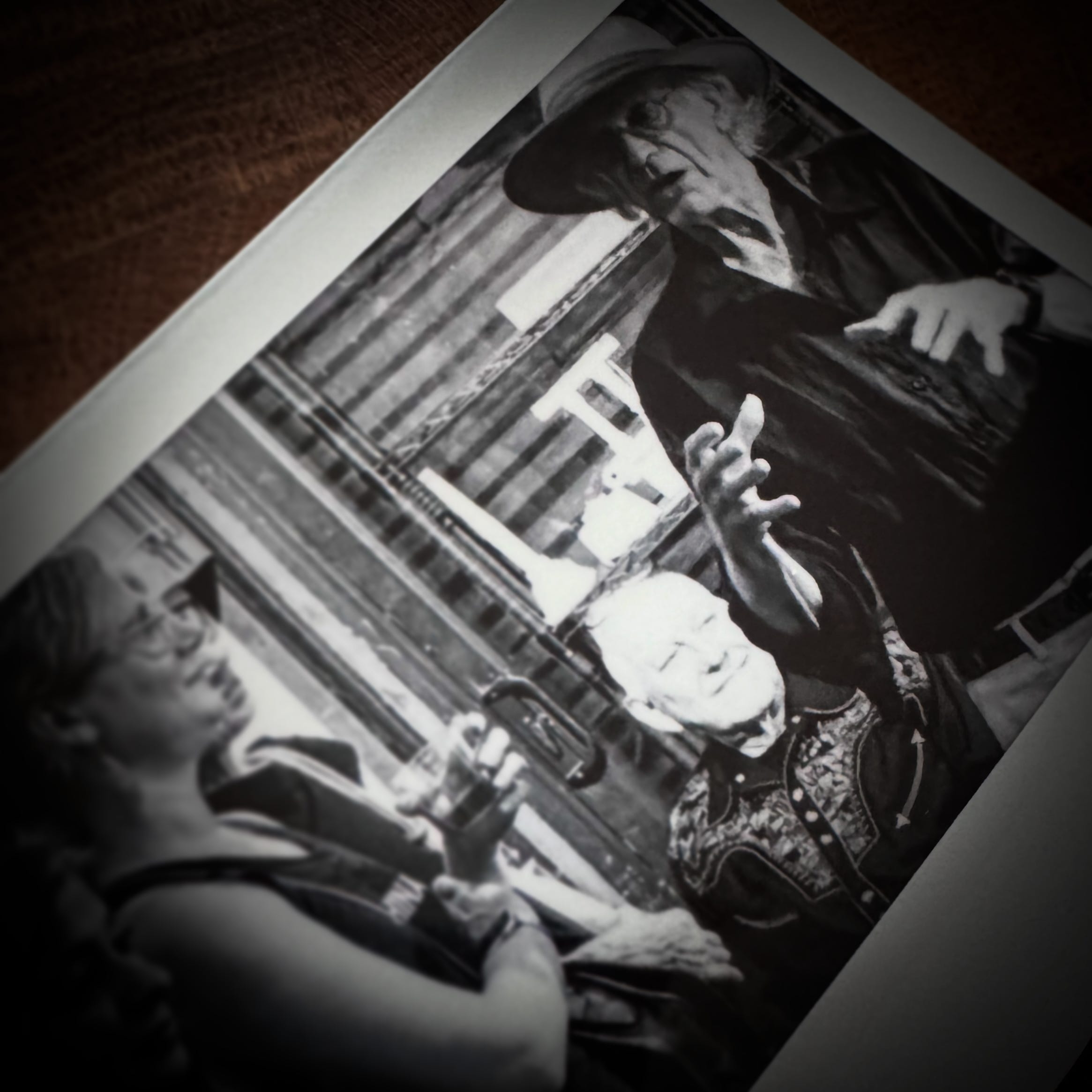
My friend Pliny Fisk died this week. He had ALS. I’ve written too much about ALS and hope I will be done soon. Pliny was an architect, an environmentalist, a teacher, and a pioneer in sustainable design. There will be people far more qualified than I am to explain what he changed about architecture, materials, buildings, and the way we think about living on this planet, but I know Pliny spent half a century asking how we might build differently, with the land rather than merely on top of it. He co-founded Austin’s Center for Maximum Potential Building Systems in 1975, and his work with his wife, Gail Vittori, helped establish the conceptual framework for Austin’s municipal green-building program, which went on to receive recognition at the 1992 UN Earth Summit. He was a rascal who loved to stick it to “The Man” in showing a better way, a better future, for everyone.
What I can really tell you is what he changed about architecture parties. I was often the only non-architect in the room. This is not an ideal situation for a writer. Everyone is talking about buildings and materials and systems, and I’m standing there wondering whether I can reasonably spend another twenty minutes examining the cheese.
Then Pliny would find me.
Somehow, at nearly every one of those parties, he would corner me, not to explain architecture, but to tell me a story, usually a silly one. Pliny was a wonderful storyteller. He’d lean in, begin somewhere that seemed completely unrelated to where we were going, take three or four detours, and suddenly I wasn’t the guy who didn’t belong at the architecture party anymore. I was Pliny’s audience, in the corner, and, more importantly, his friend.
We talk a lot about the things people build in their lives. Pliny built extraordinary things. He spent his life thinking about how human beings might inhabit the world more thoughtfully, more responsibly, more sustainably, but sometimes what you build is much smaller. Sometimes you notice the person standing at the edge of the room. You walk over. You tell them a silly story. You make them feel like they belong.
I loved Pliny. In all my travels, he was the kindest trouble-making rapscallion I ever met. He made people belong.
I’m going to miss being cornered.
I’m going to miss my friend.
The End
Note: In building The Braunologue over the past three years, I planned to publish a new essay every other Sunday that would go in-depth on an idea or personal story, as I have stated in other posts, but I also wanted to drop in short moments from the in-between places at random every now and thens. As Special Agent Dale Cooper said in Twin Peaks, “Every day, once a day, give yourself a present. Don’t plan it, don’t wait for it. Just let it happen.” In this postcard, this is what I let happen.
The Braunologue is free because paywalls are fascist, and my father did teach me to fight fascism, but I do take donations and used cars, like an NPR station.
Nice. Totally there. I was friends with Pliny and Gail for close to 40 years. Gail and I were at UMASS Amherst in the same class. Didn't know her, she lived in the smart dorm. No surprises, she is really smart. I went to Max's Pot in 1989. Don't know exactly why I didn't enlist. But in my work I was always trying to do what Pliny and Gail did. Did ok. Have a basket of first cases. Mostly it was like the Leonard Cohen song: They sentenced me to 20 years of boredom, trying to change the system from within. Real world but the fight is everything. Last time I visited in the fall of 2024 was best of times. We talked about everything, I showed Pliny what I was working on, and we watched the world series and ate spaghetti. They broke the mold when Pliny was formed. Stay in touch! Robin rbtelknm6@gmail.com
As a non architect (and writer) who is often the only non architect in a room (or party), I feel this keenly.
I always appreciated Pliny's ability to connect personally in the way that you so eloquently describe here. Thank you for taking the time to capture that part of his essence so beautifully. I loved Pliny, too, and thank you for saying THAT so plainly.
This is a lovely essay and I'll be pointing others to it. You are celebrating something about Pliny as a human, not just Pliny the brilliant thinker and innovator.